The difference between self-reflection and rumination
What separates reflection from rumination, why two people thinking about the same thing land in different places, and a test for which one you're doing.
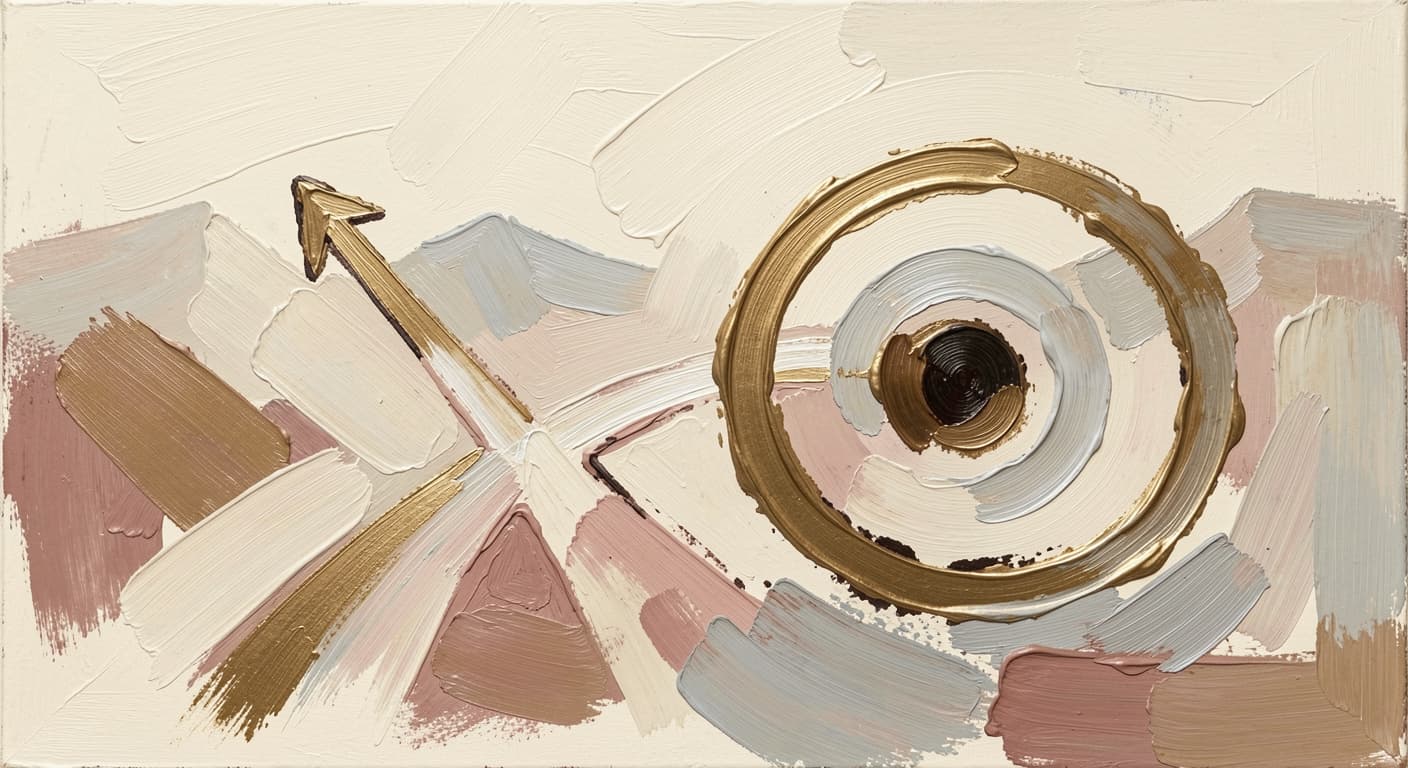
Reflection moves toward an observation. Rumination loops without one. Both involve sustained, self-focused thought; both can look identical from the outside. The difference is in what the thinking produces. Reflection ends with the looker more clearly oriented than they began. Rumination ends with the looker more wound up and no clearer.
This distinction is one of the most useful in the literature on self-focused attention, and one of the most under-explained in the popular guides to self-reflection. The boundary between the two is recognizable in the moment, supported by decades of research, and the practical test for which one you're doing right now is more reliable than most people realize.
Two activities, one outward shape
A person sitting alone, thinking about a difficult conversation from yesterday, can be doing one of two very different things.
If they are reflecting, they are looking at the conversation. Specific moments come into focus. They notice something: a sentence they didn't quite mean, a feeling they hadn't named, a pattern that was visible only in retrospect. After ten minutes, they close the page (or stand up from the chair) with at least one specific thing they didn't see before.
If they are ruminating, they are circling the conversation. The same sentences replay, in different orders. Imagined responses get rehearsed, revised, rehearsed again. The body tightens. After ten minutes, they have processed nothing new, the conversation feels worse than it did before they started, and the next ten minutes will be more of the same.
From the outside, the two activities look identical. From the inside, they feel different in ways that are hard to articulate but easy to recognize once you've been shown the distinction.
What the research found
The empirical separation of these two activities is one of the cleaner stories in personality psychology.
Trapnell and Campbell's distinction
Trapnell and Campbell (1999), in the Journal of Personality and Social Psychology, started from a well-known measurement problem: existing scales of private self-consciousness lumped together two qualitatively different traits. People who scored high on the scale weren't a uniform group. Some were anxious self-watchers focused on what was wrong with them; others were curious self-observers focused on understanding their own experience. The two profiles correlated with very different outcomes: depression, anxiety, and neuroticism for the first; openness to experience and slightly higher well-being for the second.
Trapnell and Campbell built a new instrument that separated these traits cleanly. They called the first rumination and the second reflection. The two scales correlated only weakly with each other, and they predicted different things in different directions. The distinction has held up across two and a half decades of subsequent research.
Brooding versus reflective pondering
The rumination side itself turned out to be heterogeneous. Treynor, Gonzalez, and Nolen-Hoeksema (2003), in Cognitive Therapy and Research, factor-analyzed the most widely used rumination scale and found two subcomponents that correlated very differently with depression over time.
Brooding (described as a moody, passive comparison of one's current situation with some unachieved standard) predicted concurrent and prospective increases in depressive symptoms. Reflective pondering (described as a more purposeful, problem-solving-oriented turning toward one's mood) was either neutral or mildly protective in the same studies. Same scale, two factors, different outcomes. The popular term rumination covers both, which is part of why the popular advice on it is muddled.
Abstract versus concrete processing
A different research program, summarized in Watkins (2008) in Psychological Bulletin, asked a different question: what makes the same content of thought helpful in one mode and harmful in another? The answer Watkins synthesized across many studies was about processing mode. Abstract processing (asking why am I like this? what does this mean about me?) tends to predict worse outcomes. Concrete processing (asking what was happening just before I felt this? what did I actually do?) tends to predict better ones.
This converges with the Trapnell-Campbell and Treynor distinctions, but adds a piece. The boundary between reflection and rumination isn't only about temperament or motivation. It is also about the level at which the thinking is conducted. The same person, on the same problem, can ruminate when they ask abstract questions and reflect when they ask concrete ones. The level you operate at is something you can change deliberately.
A test for the moment
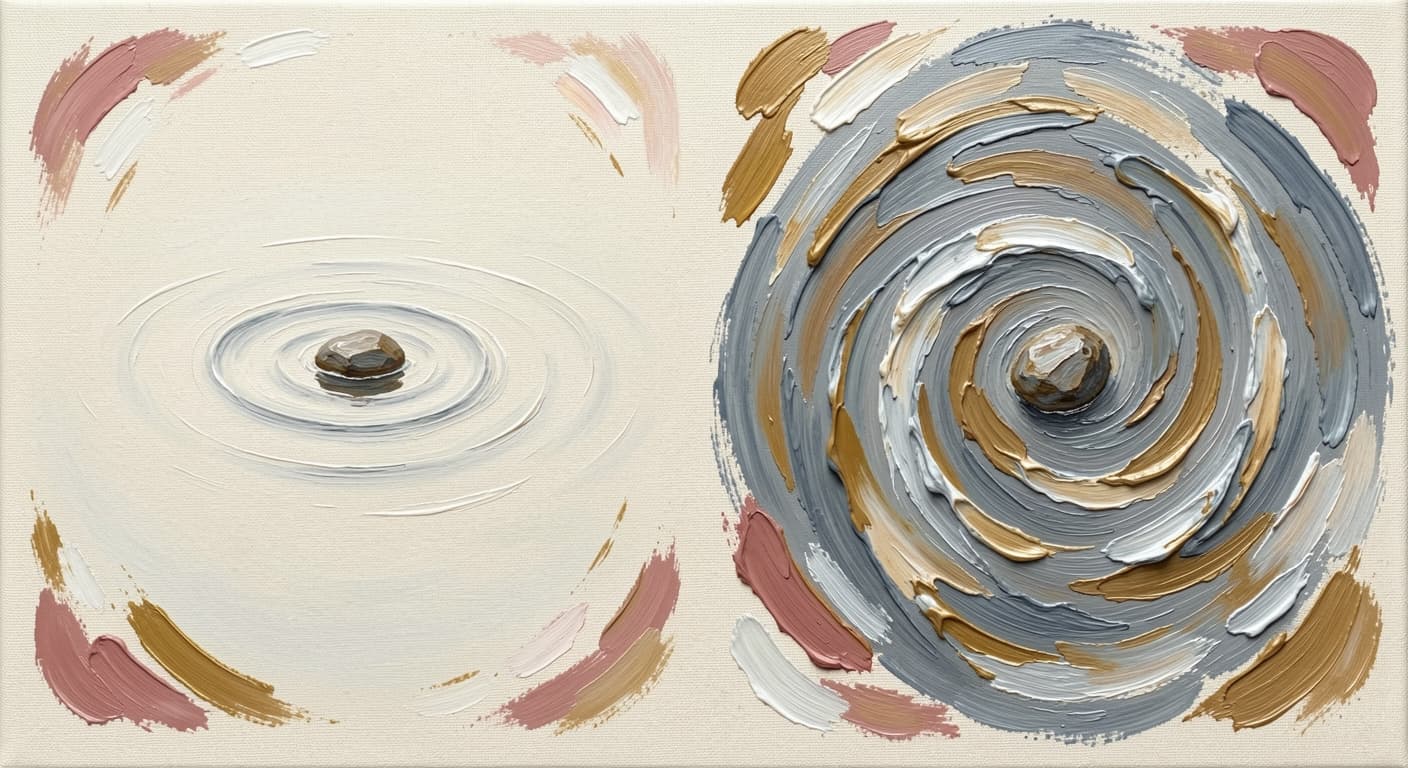
Three signs reliably distinguish the two activities while they are happening.
The motion test. Reflection moves; rumination loops. After three or four minutes of sustained thought, ask yourself: have I noticed at least one specific thing I hadn't already seen at the start? If yes, you're reflecting. If no, and especially if you're rehearsing the same sentence in different words, you've moved into rumination.
The body test. Reflection produces a kind of opening. The shoulders are not necessarily relaxed but the breath is moving; the body is engaged but not tightened. Rumination produces tightening: jaw, shoulders, stomach, breath that has gone shallow without your noticing. The somatic signature is reliable and accessible. If you feel like you're solving something but your body is bracing, your body is right.
The level test. Listen to the question your mind is asking. What did I want her to do that she didn't? is concrete. Why am I the kind of person who reacts this way? is abstract. The first leans toward reflection. The second leans toward rumination. The same situation can be looked at either way; the level of the question shapes the activity more than the content does.
You don't need all three. Any one of them, applied honestly mid-session, gives you the information you need.
When you find yourself in the loop
Catching the slide from reflection into rumination is the first move. The second is interrupting it without making the situation worse.
Three things that work, in roughly the order you should try them.
Change the level. If your question was abstract, replace it with a concrete one. Why am I always like this? becomes What specifically did I do in the past hour? The concrete question gives the mind something with edges. Often the loop dissolves the moment the level shifts, because the abstract question had nothing to land on in the first place.
Move the body. Stand up. Walk for two or three minutes, ideally outside. The interruption is not a distraction; it is a context shift that breaks the body's bracing pattern. When you sit back down, the same situation often looks different, not because you've solved anything but because the body is no longer treating it as a threat.
End the session. If neither of the above resets the loop, the session is over for today. Reflection is supposed to produce one observation per session; rumination produces zero. Forcing more time on a session that has gone into rumination produces more rumination, not eventually-arrived-at insight. Close the page. The question will still be there tomorrow, and tomorrow you may have a different angle on it.
What does not work: trying harder to reflect, telling yourself to just stop ruminating, or moralizing about the rumination. The loop tightens under direct pressure. The exits are lateral, not frontal. Two written practices that act as lateral exits when rumination shows up on the page: witness journaling (write only what happened, no commentary) and switching the grammatical voice you use about yourself from first to second or third person.
A small exercise

Pick a recent moment that has been pulling at your attention: a conversation, a small failure, a worry that keeps surfacing. Set a five-minute timer. Write a single concrete question at the top of a page (begin it with what, not why). Spend five minutes writing toward an observation, not toward a conclusion. When the timer goes off, note one thing: did the time produce a specific observation, or did it loop? If it produced an observation, the session worked and you can decide later whether the observation needs an action. If it looped, you've just learned that this particular question, in this particular moment, slides toward rumination — and now you know to change the level the next time.
If you'd rather try this with the structured form Mirror Field is built around, start a session here.
Sources
- Trapnell, P. D., & Campbell, J. D. (1999). Private self-consciousness and the five-factor model of personality: Distinguishing rumination from reflection. Journal of Personality and Social Psychology, 76(2), 284–304. https://doi.org/10.1037/0022-3514.76.2.284
- Treynor, W., Gonzalez, R., & Nolen-Hoeksema, S. (2003). Rumination reconsidered: A psychometric analysis. Cognitive Therapy and Research, 27(3), 247–259. https://doi.org/10.1023/A:1023910315561
- Watkins, E. R. (2008). Constructive and unconstructive repetitive thought. Psychological Bulletin, 134(2), 163–206. https://doi.org/10.1037/0033-2909.134.2.163
You may like
The body in self-reflection
Why the body's signals belong in reflective practice, what interoception research has shown, and a working pattern for noticing somatic information without forcing it.
What self-reflection actually does
What self-reflection actually does, what it doesn't, where the classical traditions and research agree, and the line between reflection and rumination.
Anger on the page
Writing about anger does something different than writing about other emotions. What changes when anger meets the page, what helps, and the popular advice that does more harm than good.