The five-minute session
Short reflective sessions are not just abbreviated long ones. What a five-minute session actually does well, what it can't do, and the structural shape that makes the constraint productive.
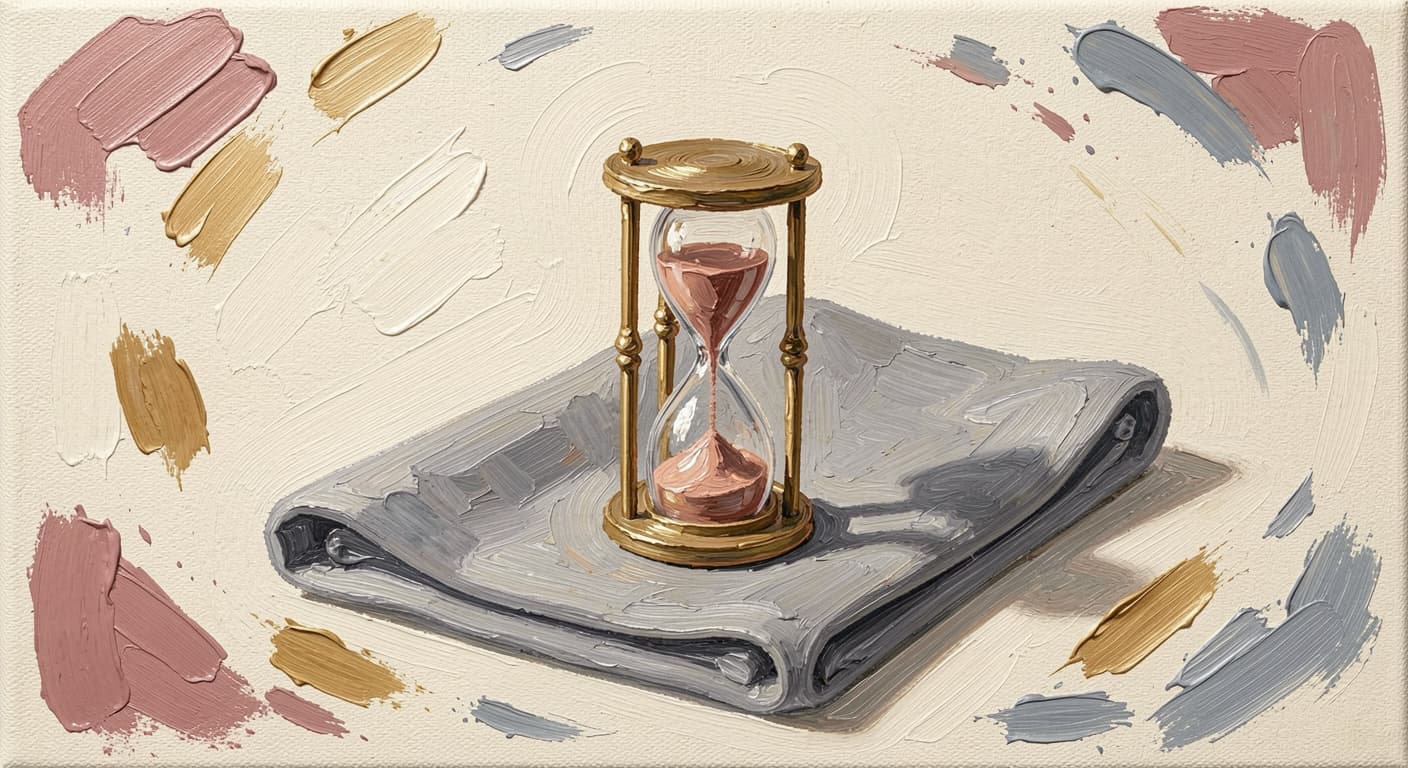
Most journaling guides assume a session is at least twenty minutes. Some recommend an hour. There is a different practice — a five-minute session, run as a standalone form rather than a degraded version of a longer one — that does specific work well, and is worth understanding on its own terms before dismissing it as a shortcut.
Short isn't a worse version of long
The five-minute session is sometimes treated as what you do when you don't have time to do it properly. That framing is wrong on its own terms. A long session and a short session are different practices, with different mechanisms.
A long session lets material surface gradually. The first ten minutes warm up. The actual work tends to happen in the second half. Long sessions are good for unfinished material that needs incubation time on the page.
A short session has none of that. The constraint forces you straight to whatever is most present. The five-minute session is good for a specific thing the long session is bad at: arriving at the one sentence that is most true right now.
Both are useful. They are not interchangeable.
The structural shape that makes it work
The five-minute session has a different shape than a clipped long session. Three structural moves keep it productive.
One specific question, decided before starting. Not what's on my mind? The open question wastes the first two minutes on orientation. The five-minute session needs a tight one. What am I avoiding right now? What did I want to say earlier and didn't? What would I tell a friend in my situation? Pick one before the timer starts.
Set the timer. Five minutes, hard stop. The constraint is the practice. Without the timer, the session bleeds into a longer one that doesn't have the long-session structure either, and falls into the gap between forms.
Stop mid-sentence if the timer goes off there. Don't finish the thought. The discipline of stopping is part of what trains the practice, and the unfinished sentence is sometimes the most useful artifact — you'll know exactly where to start if you return to the same question later.
What it does well
Disrupting rumination. A short, structured session interrupts the spiral that an unstructured ten-minute thinking-period would feed. The page is harder to recurse on than the inside of your head.
Daily continuity. A five-minute practice survives weeks where a thirty-minute one doesn't. Most reflective practices die from too-high a bar, not from too-low. The five-minute session is sometimes what keeps the longer practice alive on its bad weeks.
Locating where you are. The form is good at producing one accurate sentence about the current state — the kind of sentence a long session will sometimes circle for half an hour without arriving at.
What it can't do
Work through something complex. Anything that needs incubation — a stuck decision, a relationship pattern, a creative block — usually doesn't yield in five minutes. The short session might surface the question, but the answering happens elsewhere.
Replace longer sessions entirely. A practice that is only five-minute sessions becomes a kind of constant micro-locating without the deeper integration the longer form provides. The two work best alternating.
Process acute emotion. A short session in the middle of an emotional crisis often raises the temperature without lowering it. The form is for clear-headed micro-locating; emotional processing wants room.
When to use it
Three situations where the five-minute session is the right tool:
The morning, before the day begins. One question — what do I want to be true about today by tonight? — answered in five minutes can shape the next eight hours more than a forty-five-minute session that runs into the workday.
The end of a difficult conversation, before reentering the rest of your day. Five minutes to locate what just happened keeps the rest of the day from being colored by an unprocessed exchange.
A travel day, a busy week, a stretch when the longer practice isn't possible. Five minutes a day for two weeks keeps the practice alive in a form that can return to its full shape afterward.
If you want a structured short session that returns a question rather than asking you to invent one, a Mirror Field session is roughly ten minutes and produces one sharper question rather than a long entry.
A small exercise
Right now, set a timer for five minutes. Pick one question: what am I avoiding writing about? Write toward it for the full five minutes. When the timer goes off, stop, even if mid-sentence. Close the notebook.
Try this once a day for a week. You will find out in seven days whether the form is one your practice has been missing.
You may like
Journaling through transitions
Why reflective writing during a job change, move, or relationship ending has a different shape than ordinary practice, and what each phase of a transition asks for on the page.
Journaling without privacy
What to do when you don't have a private place to keep a journal — shared homes, traveling, partners who read each other's things. The practical workarounds and what each costs.

Leaving sessions unfinished, on purpose
Most journaling guides assume a session has a tidy ending. Stopping mid-thought, deliberately, is a different practice with its own logic — and one that produces better next sessions.