The Old English Rune Poem in plain language
What the Old English Rune Poem is, what it isn't, and what its 29 stanzas actually say — in plain modern English, with the manuscript history that the popular rune-meaning books usually skip.
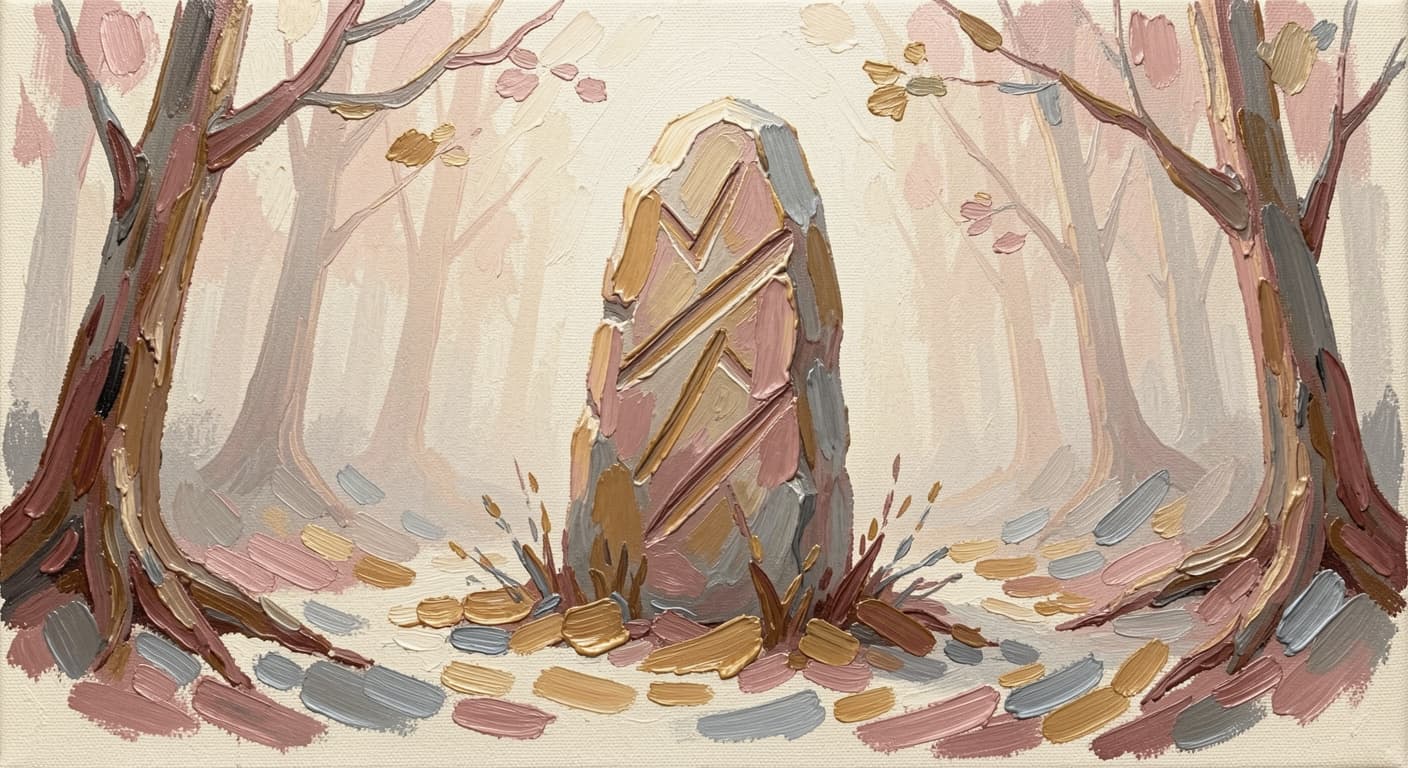
The Old English Rune Poem is the closest thing we have to a primary source on what the runic letters meant to the people who used them. It is not a divination manual. It is not a fortune-telling system. It is a 10th-century mnemonic poem, twenty-nine short stanzas long, each one naming a rune, glossing its meaning, and giving a single image. The popular rune books that present a tidy table of Rune = Concept mostly inflate, simplify, and modernize the poem into something it wasn't — but the actual stanzas, read carefully, are still the most useful starting point for anyone trying to use runes as a reflective lens rather than a magical kit.
This is a plain-language guide to what the poem is, where it came from, what we actually know and don't know about it, and how the original stanzas read once the modern wellness vocabulary has been stripped off.
What the poem is
The Old English Rune Poem (often abbreviated OERP) is a 10th-century English text preserved in a single manuscript: the Cotton MS Otho B.x, which burned in the 1731 Cottonian Library fire. Our access to the poem is through George Hickes's 1705 Linguarum Vett. Septentrionalium Thesaurus, which had transcribed the manuscript before it was lost.
It contains 29 stanzas, one per Anglo-Saxon futhorc rune. (The Anglo-Saxon futhorc is a 29-rune extension of the older 24-rune Elder Futhark; the OERP covers the longer set, but the most-discussed runes overlap with both alphabets.) Each stanza is three to five short alliterative lines.
What the poem is not:
- It is not a divinatory manual. There is no instruction in the text on casting runes, drawing them, or interpreting them as oracles.
- It is not pre-Christian. The manuscript dates to the late 10th century, well after Anglo-Saxon Christianization. Several stanzas have explicit Christian register; others are pre-Christian in sensibility but were preserved by Christian scribes.
- It is not consistent. Some stanzas are clear-edged practical descriptions (cattle, wealth, ice). Others are gnomic, with multiple plausible readings. The popular books usually pick one reading and present it as definitive.
What it actually does
Each stanza follows roughly the same shape: name the rune, give one or two concrete properties of the named thing, and close with a moral or experiential observation. The structure is mnemonic, designed to be memorized, not encyclopedic.
The classic example is the stanza for Os (the mouth rune), already quoted in our self-journaling pillar. Here it is again, in the original Old English:
ᚩ os byþ ordfruma ælcre spræce, wisdomes wraþu ond witena frofur and eorla gehwam eadnys ond tohiht.
A plain-language translation:
Mouth is the source of all speech, a stay of wisdom, a comfort to the wise, and to every person both blessing and hope.
(Translation by Mirror Field, working from the Old English with reference to Dickins, 1915.)
Three things to notice:
- The rune is named after a concrete thing (mouth), not a concept (communication).
- The metaphorical extension (mouth → speech → wisdom) is built into the poem itself; the rune isn't a label for an abstraction.
- The closing line is observational, not prescriptive. It does not say use this rune for clear communication. It says: speech is, in human life, both blessing and hope.
This pattern recurs across all 29 stanzas. The runes are not symbols of psychological qualities (the way modern decks position them). They are names for material things, and the stanza unfolds the human meaning of that thing in two or three lines.
Five stanzas in plain language
To make the texture of the poem visible, here are five of the most-cited stanzas in plain modern English. Translations are Mirror Field's, working from the Old English with reference to Dickins (1915) and Page (1999).
Feoh (cattle, wealth)
Wealth is a comfort to every person, yet each must give it freely if they hope to win glory in the eyes of the lord.
Wealth as a tested good. Held tightly, it does not produce what it promises. Released, it does.
Rad (riding, journey)
Riding seems easy to one in the hall, harder to one who sits the strong horse over the long road.
The poem makes the rider's-eye view visible. The journey looks different from the saddle than it does from the bench by the fire.
Cen (torch)
Torch is known to every living person by its flame; bright and clear, it most often burns where the nobles rest within.
A small image. Light in a room of seated people. The torch is what makes the gathering legible.
Ger (year, harvest)
Year is a hope for every person, when god, holy king of heaven, lets the earth give her bright fruits to high and low alike.
The yield of the year as something that arrives, not something seized. The stanza is explicitly Christian in register, but the underlying figure (patience, return, harvest) predates the manuscript by centuries.
Eoh (yew tree)
Yew is a tree with rough bark outside, hard and fast in the earth, keeper of fire, rooted below, a delight on the homestead.
The yew is paradoxical: a tree that holds fire (it was used for kindling and for bows). The stanza names the paradox without resolving it.
These are not five concept-labels. They are five small images, each one a viewing-angle on a piece of human experience.
What the popular books got wrong
Three things the modern rune-meaning genre tends to do that the original poem doesn't.
Over-systematization. The poem doesn't present the 29 runes as a coherent system covering the whole of human life. It presents 29 small stanzas, each one a self-contained unit, with overlap and gaps. The popular books smooth the gaps and create artificial completeness — prosperity, journey, partnership, breakthrough, inheritance — that reads like a self-help curriculum and doesn't match the source.
Reverse meanings ("merkstave"). Many modern rune books assign each rune a reversed or merkstave meaning. This is a 20th-century invention. The Old English poem assigns no reversed meaning to any rune. The practice was largely introduced by Edred Thorsson and Ralph Blum's books in the 1980s and has no medieval source.
The blank rune. Ralph Blum's 1982 The Book of Runes added a 25th blank rune to the Elder Futhark, framed as Wyrd or fate. There is no medieval precedent for this. The Old English Rune Poem's 29 stanzas correspond exactly to the 29 named futhorc runes; there is no blank, no Wyrd-rune, no 25th. Blum's blank rune is the most successful invented detail in modern rune practice, and it is purely modern.
If you've used runes with reversed meanings or with a blank, you've been using a 20th-century divinatory system, not a medieval one. Both are legitimate practices to engage with, but they should be named accurately.
How to use the poem as a reflective text today
Three practical uses for the OERP in a contemporary reflective practice.
Read the stanza as a small image. When a rune comes up in a session — cast at random, or chosen — open the poem to its stanza and read the three or four lines slowly. The stanza is short enough to hold in mind. Don't try to extract a meaning. Look at the image and let it sit beside whatever you brought to the session.
Look for the closing observation. Each stanza closes with an observational line: and to every person both blessing and hope (Os), each must give it freely (Feoh), harder to one who sits the strong horse (Rad). These are the lines doing the most reflective work. They are usually the most useful place to start.
Resist the modern overlay. If your association to a rune comes from a book published after 1980, set it aside for a session and work only with the stanza as it reads. The medieval text and the modern divinatory system are genuinely different practices. Both can be useful; they should not be conflated.
If you want a structured form that pairs a rune with two other classical lenses (a hexagram and a Hermetic power) and produces a returned question, a Mirror Field session does exactly this. The runes there are read against the Old English source, not against any of the modern rune-meaning conventions.
A small exercise
Pick a rune you have an association with. Look up its stanza in the OERP. (Dickins 1915 is in the public domain and freely available; Page 1999 is the standard scholarly reference.) Read the stanza twice — once silently, once aloud. Without writing yet, sit for two minutes with what the stanza is actually saying.
Then, in three sentences, name what the stanza notices that you hadn't noticed yet. If nothing comes, the stanza has done what it was going to do for now. The OERP is a slow text. The work of it accumulates across many readings, not within one.
Sources
- Dickins, B. (1915). Runic and Heroic Poems of the Old Teutonic Peoples. Cambridge University Press. [Public domain. The standard scholarly edition of the Old English Rune Poem.]
- Page, R. I. (1999). An Introduction to English Runes (2nd ed.). Boydell Press. ISBN 978-0851157689. [Critical introduction with extended discussion of the OERP's manuscript history and translation issues.]
- Hickes, G. (1705). Linguarum Vett. Septentrionalium Thesaurus. Oxford. [The transcription that preserves the OERP after the manuscript was destroyed in the 1731 Cottonian fire.]
You may like
Three classical views of fear
Fear is harder to map across the three classical traditions than other emotions are. Where the I Ching, the Old English Rune Poem, and the Corpus Hermeticum each have something to say about fear — and what the partial mappings reveal about what fear is.
What a classical practitioner would have asked at 3am
The 3am thought is not a modern invention. What a Confucian, an Anglo-Saxon scop, and a late-antique Hermetic practitioner would each have asked themselves in the same hour, and what the convergence reveals.
Where the ten Hermetic powers come from
The ten Hermetic powers — the third lens Mirror Field uses — come from a specific dialogue in the Corpus Hermeticum. What that dialogue actually says, what's contested, and what the popular Hermetic content usually skips.