Three classical views of fear
Fear is harder to map across the three classical traditions than other emotions are. Where the I Ching, the Old English Rune Poem, and the Corpus Hermeticum each have something to say about fear — and what the partial mappings reveal about what fear is.
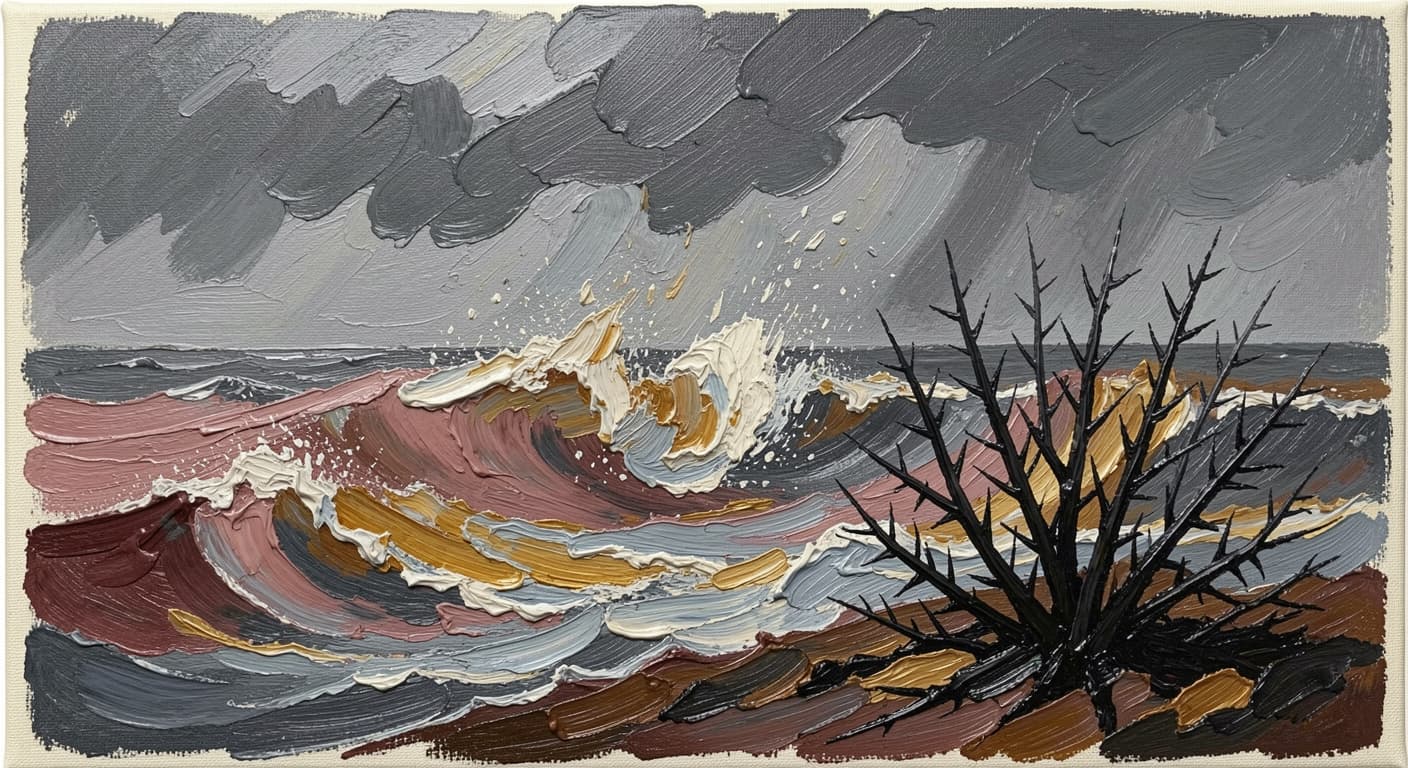
Fear, in modern usage, is one of the basic emotions. Translation across language and culture treats it as a near-universal: every culture has a word for it; every developmental psychology lists it in the basic-affect set. So it is striking, working with the three classical reflective traditions Mirror Field draws on, to find that fear doesn't translate cleanly into any of their primary vocabularies. The I Ching, the Old English Rune Poem, and the Corpus Hermeticum each have something to say about something fear-adjacent, but none has a single concept that the modern English word lands on without remainder.
This is itself information. The mismatches are not errors of mapping. They suggest that what we call fear is not, in the classical reflective vocabulary, a single thing.
I Ching: Hexagram 29, Kan (the Abysmal)
The I Ching's closest treatment of fear arrives obliquely through Hexagram 29, Kan, usually translated as the Abysmal or Water or Danger. The hexagram is composed of two water-trigrams stacked, and the standard English glosses treat it as the hexagram of real danger encountered.
But the hexagram does not address fear directly. The judgment text speaks instead of sincerity (信, xìn) and the right relation to danger: the abysmal repeated, sincere; what fills the heart will succeed. In Lynn's translation of Wang Bi, the hexagram becomes a treatise on how to act under conditions of true threat. Wang Bi reads the doubled water as the situation in which danger is not a passing condition but the medium one must move through.
What is striking is what the hexagram does not say. It does not name the affect of fear. It names the situation that produces fear (genuine danger) and the right action under that situation (sincerity, sustained presence, no false moves). The fear itself is treated as something that may or may not arise; the hexagram is concerned with what you do regardless of which.
This is a useful angle on fear that modern psychology underemphasizes: fear is sometimes downstream of correctly perceived danger. The work is not to manage the affect; the work is to act rightly given the danger. Kan is the I Ching's closest term for fear, and what it actually addresses is response to genuine danger. The two are not the same.
Rune: Þorn (thorn)
In the Old English Rune Poem, the rune that comes closest to fear is Þorn. The stanza, in plain language:
Thorn is fiercely sharp; for any thane who grasps it, it is grim, and immeasurably cruel to any man who rests among them.
The thorn names a danger that is sharp, present, and produces real injury. Like the hexagram, the rune's stanza does not name the affect. It names the thing-encountered, the property of which is that it cannot be casually grasped. The fear is implicit in the warning, not stated.
The rune's framing is different from the hexagram's. Kan names the situation: a flooded landscape, danger as medium. Þorn names the object: a sharp particular thing that must be approached carefully or not at all. Both are pre-affect. Both treat what we call fear as a downstream signal of an upstream reality.
There are other runes adjacent to fear in the OERP — Hægl (hail) describes a sudden disruption from above; Nyd (need) describes constraint that bears down on the heart. None of them addresses fear as such. The rune poem's silence on the affect is consistent with its general orientation: it names things in the world and leaves the reader to bring their own interior to the encounter.
Hermetic: fear is not on the list
The most striking treatment of fear comes from the Corpus Hermeticum, which doesn't treat it. CH XIII's list of twelve tormentors — the forces that govern the unreborn soul — includes ignorance, sorrow, intemperance, lust, injustice, greed, deceit, envy, treachery, anger, recklessness, and malice. Fear is not on the list.
This is conspicuous, because the list aims at completeness. The dialogue presents the twelve as the full set of forces that produce the suffering soul; the ten powers, when they enter, drive these out. If fear were a primary tormentor, it would be there.
What the dialogue does instead is locate fear-adjacent material under several of the named tormentors. Recklessness is the failure to be appropriately cautious. Treachery is the response to fear of betrayal. Malice and anger are sometimes downstream of fear. Deceit is sometimes the strategy of someone afraid of direct truth. The dialogue treats these as the actionable forms; fear itself is left unnamed because, in the dialogue's frame, it is not a thing that can be addressed directly. What can be addressed is what fear produces.
This is the boldest of the three classical readings. The Hermetic position, taken seriously, is that fear is a folk-psychological category that doesn't carve nature at its joints. The forces that move the soul are more specific: the recklessness, the treachery, the deceit, the malice. Treating fear as primary, the dialogue suggests, displaces attention from the actionable forces onto a generalized state.
What the three views reveal together
None of the three traditions treats fear as a single thing to be addressed in itself. The I Ching addresses it indirectly through response to danger. The rune addresses it through the sharp thing encountered. The Hermetic dialogue addresses it not at all, treating its named effects (recklessness, anger, deceit, malice) as the actionable layer.
What this convergence suggests is that fear in modern usage is a cluster, not an atom. It includes:
- Appropriate response to real danger (the Kan layer)
- Recoil from a particular sharp thing (the Þorn layer)
- Several downstream behaviors that are themselves the actionable layer (the Hermetic layer)
For reflective practice, the practical implication is that I am afraid is not yet a usable diagnosis. The next question is which of the three layers the fear belongs to.
If it is the Kan layer, the work is sincerity under genuine threat. The fear is data about the situation; the question is right action.
If it is the Þorn layer, the work is recognizing the particular sharp thing being encountered. The fear is appropriate; the question is whether to grasp it now or not at all.
If it is the Hermetic layer, the work is on the downstream forms — the recklessness, the anger, the avoidance — because the fear itself isn't, in the dialogue's frame, the right level of address.
Most experienced fear is some mixture of the three. The classical traditions, taken together, are unanimous on one point: the affect is not where the work happens. The work happens upstream (real danger, particular thing) or downstream (specific forms of response). Fear in the abstract is too coarse a category to act on directly.
A small exercise
Pick a fear you have been carrying. Without trying to manage it, write three short paragraphs:
- Is there a real danger here that the fear is correctly registering? If yes, name it. The work is then sincerity under threat.
- Is there a particular sharp thing being encountered? Name it as a specific object, not a category. The work is then recognizing what cannot be casually grasped.
- What downstream behaviors is the fear producing? Name two or three. The work is often most actionable here: not the fear itself, but the recklessness, avoidance, deceit, or anger that follows from it.
If you want a structured form that holds one fear-adjacent question against three classical lenses, a Mirror Field session is built for this. The lenses do not promise to dissolve the fear. They promise to make the difference between the fear and the actionable layer easier to see.
Sources
- Lynn, R. J. (1994). The Classic of Changes: A New Translation of the I Ching as Interpreted by Wang Bi. Columbia University Press. ISBN 978-0231082945. [Hexagram 29, Kan, pp. 308–315.]
- Dickins, B. (1915). Runic and Heroic Poems of the Old Teutonic Peoples. Cambridge University Press. [The Þorn stanza.]
- Copenhaver, B. P. (1992). Hermetica. Cambridge University Press. ISBN 978-0521425438. [CH XIII §7, on the twelve tormentors.]
You may like
What a classical practitioner would have asked at 3am
The 3am thought is not a modern invention. What a Confucian, an Anglo-Saxon scop, and a late-antique Hermetic practitioner would each have asked themselves in the same hour, and what the convergence reveals.
Power 1: Ignorance to Gnosis
The first of the ten Hermetic powers in CH XIII drives out ignorance. What the dialogue actually means by *gnosis*, and how to use the contrast as a reflective lens — without the modern self-help flattening.
Power 2: Sorrow to Joy
The second of the ten Hermetic powers in CH XIII drives out sorrow. What the dialogue means by *Knowledge of Joy* — and why it isn't what the modern wellness vocabulary calls happiness.